
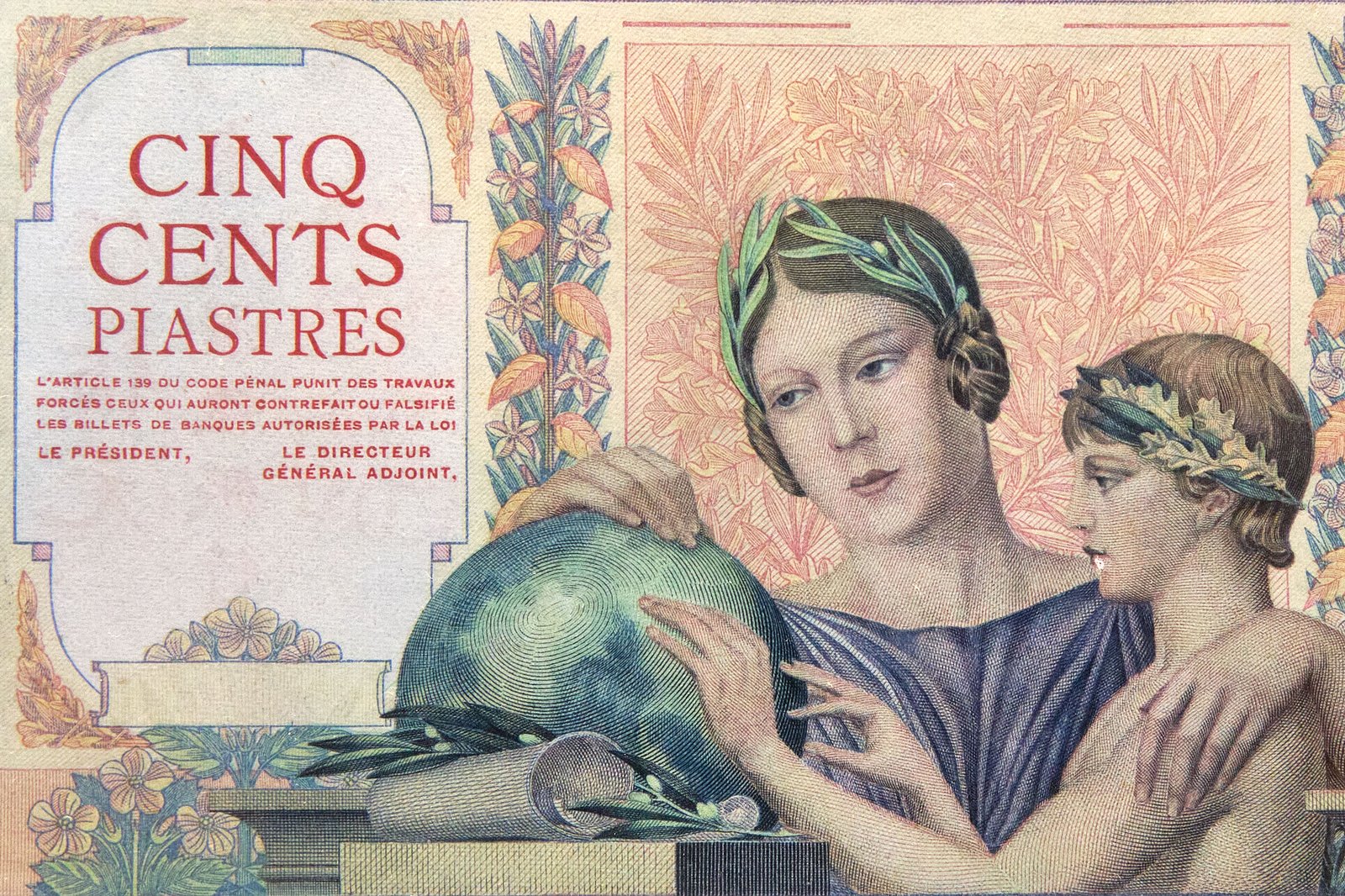
The other day, we had the chance to visit an exhibition on Vietnamese currency at the State Bank of Vietnam. It was an experience that left us both impressed and quietly intrigued.
From the Indochinese banknotes of the French colonial period, crafted with remarkable detail and advanced printing techniques, to later Vietnamese notes featuring Uncle Hồ alongside familiar scenes of everyday life, labor, and national defense, each piece carries its own story. Beyond their function as a medium of exchange, these banknotes act as visual records, reflecting different chapters in the country’s development, from wartime to the present.
At its core, money is an abstract concept, built on trust and collective agreement. Yet when materialized into physical notes, it becomes something tangible, layered with meaning. What draws us in, however, is not merely its value, but its visual dimension: the composition, the illustration, the intricacy of details, and the craftsmanship behind the printing.
Looking closely at these older notes, one begins to notice the level of care embedded in each element, from ornamental patterns to human figures, from narrative imagery to technical execution. There’s a subtle intersection between art, craft, and history, where each banknote becomes more than currency, it becomes a form of design that preserves cultural memory.
Perhaps, if we set aside the idea of value for a moment, we can begin to see money simply as a visual object, something to observe, to understand, and to appreciate.


